I’ve been watching the story of BP the past couple of weeks, and how the mess they created (and I’m not just taking oil here) has got worse and worse. So, if like me until a little while ago, you’re sitting in the corp comms team of a large corporate, one that is only one c*ck up away from a BP-style crapstorm, what can we all learn from this whole situation?
Be humble
BP’s response at the very beginning of this was poor. The early attempts to deflect responsibility to their US operational partners was badly thought out and inappropriate.
Never forget that the start of this was a horrendous accident which caused the rig to catch fire and sink, killing 11 people. BP’s public official response to this was a pretty hands-off press release on 21 April, where they “offered ... full support to drilling contractor Transocean” as they evacuated the rig. A day later, they followed this up with another release, to say they were activating “an extensive oil spill response”. Nothing then, until 24 April, when their next release “offers sympathy to the families of those lost”.
In each of these releases they make significant mention of Transocean – in many ways this is understandable (and accurate, don’t forget) but was it sensible? It was clear very early on that this was going to be a significant incident and a deeply sensitive issue. A UK company being so quick to blame a US company for this, right on their doorstep, and so early on, was not sensible.
Compound this with the comments made by Tony Hayward on the now notorious CNN interview (but more of this later) it was enough to sow the seeds of discontent in the US.
Anyone would think this was BP’s first major disaster in the Gulf of Mexico.
Own the story
BP’s initial hands off approach allowed the story agenda to be set by others – in particular the US media, the US government and it’s response agencies. BP has since been responding, rather than initiating, comment on the spill. This has not panned out well!
With no quick fix, the White House has been increasingly keen to find someone to blame; to deflect criticism from southern, deeply Republican, deeply hostile states, that they are powerless (who says Hurricane Katrina did no good for anyone – it taught the White House media staff a hard lesson!). Step forward BP – conveniently listed abroad, and with much more to lose (both reputation and money) than any of the other parties who may be responsible.
Even Transocean has been happy to hide behind BP’s large, corporate, well funded skirts. A quick look at the Transocean corporate website shows some real estate on their home page given over to it, but that's about it. More interestingly, a look at their press releases shows relatively little official comment since the accident itself. And who can blame them.
The official response site http://www.deepwaterhorizonresponse.com/ was setup and is maintained by the Unified Command center (mostly US agencies with input from BP and Transocean), and is powered by Pier Systems, a US based emergency response specialist. They also manage BP’s four state-specific response sites, but more of these later. If I was being disingenuous I might even hint that BP was outsourcing their digital response, but that would be mean...
Unfortunately, the media cat is now out of the bag, and BP are in the unenviable position of being permanently on the back foot. When Congressmen are even saying that “everyone with a British accent from BP is lying to the American people” you know you have more than a passing reputational issue (will the last person in BP’s press centre please turn out the light as they leave!). Mind you, he may have a point. Today, the US Geological Survey have announced that the initial spill figures may have been significantly lower than the reality.
The Attorney General has even said that the US government will not pay a dime towards clean up and that BP will be held responsible. Now, I wasn’t aware that the cause of the initial incident had been established yet, and that culpability had been decided (step forward Transocean, Halliburton, US legislators and indeed BP). If not then BP may have a legitimate claim for prejudice and have any potential lawsuit against them contested accordingly.
Talking of which, amazingly Halliburton seems to have slipped almost unnoticed under the radar. After testifying at the Senate hearings, they seem to have ducked out quite successfully. In fact, there’s not even a mention of the oil spill on their website home page, other than a cursory financial statement about an IR call. Mind you , the Halliburton website contained very useful information about their Texas headquarters. Read whatever you want into that...
Never mind, BP did buy sponsored links to their response site from the major search engines. so that’s OK then. Media response owned. Not.
Manage your senior management better
Never let your CEO in front of the press when he’s stressed. Never. Really, never, ever do it. Have a look at that CNN interview again I’m not sure about you, but I get the distinct impression that he’s continually trying to suppress a smirk. I’m sure that’s not for any other reason than he’s stressed, tired, and generally incredibly stretched, and is no more than a human defence mechanism. But still... a bullish approach to slicing up the blame cake by a smug overseas CEO was never going to play well in Peoria. Or Alabama.
And if you insist on taking him off his leash and letting him run around in front of the press unsupervised, please warn him against either saying something tactless (like about getting his life back) or being arrogantly dismissive about the impact your incident might have in the future (compared to the size of the ocean, the spill is tiny).
Hopefully the forthcoming meeting between and Obama and the BP chairman will be better managed by BP’s comms support staff.
Engage
Unfortunately, it took far too long for BP to engage openly with their stakeholders. Their initial hands off approach didn’t lend itself to any form of engagement – which has subsequently become a damage limitation exercise. Their four local response sites have been set up by Pier, who registered the relevant domains on 14 May. That’s nearly FOUR WEEKS after the disaster. Seriously people... what’s going on?
Well, at least they had some idea of doing something – on 7 May they registered bpresponds.com which is currently used for emails. Mind you, note to Pier staff, please check the “title” tags of your websites a bit more carefully. Oh, and while you're at it, please sort out the .ico images on the HEAD element of your response sites - check out the URL bar on
http://www.ms-response.com/ to see a rather lovely hurricane image. Best not tempt fate, eh? (Bet you can't tell that Pier System saw significant business during Katrina...)
I can’t see much in any of these official BP sites that is any real attempt to engage. There’s some fairly bland info about volunteering, reporting, wildlife and so on. But nothing that really reaches out. And the tone of voice really leaves a lot to be desired. Dry, corporate, unfriendly – there’s a time and a place for content like that, but arguably this isn’t it. And if you’re going to launch an official site, please at least try to follow your own visual identity guidelines. The site design is a mess! As is the IA, the UX and all sorts of other things. But I digress.
However, on the ground it looks like BP are starting to wake up to the benefits of direct engagement. The Belle Chase Outreach meeting on 9 June, and the video, is a great start.
And the official BP response site does show evidence of what they’re doing to contain the spill, but again tone of voice is dry and corporate. Even the failures of initiatives like “top kill” are smothered in corporate language. At this point, it doesn’t help, and it’s really adding to the wider perception that BP is not acting openly and honestly. However, when you start reading sections like this on the response site you can see why the whole ToV thing is a nest of vipers for BP. This magazine-stylee, chatty verbose crap is really not appropriate in this situation.
Social media has really gone into a frenzy on this. BP have tried in Facebook http://www.facebook.com/BPAmerica and in fairness have kept the page up to date. There’s lots of commentary on their wall, and it looks like they’ve undertaken minimal editing of user posts (points for that!). Their official Twitter account has also been busy at http://twitter.com/bp_america but mostly pushing out info, not much engagement. However, I can understand this, they’re using it as an update service rather than a conversation channel.
Let dissenters have their space
Big snaps to BP on this one. They’ve allowed space for critics and dissenters to have their say (they must have learned from Shell’s issues with Royaldutchshellplc.com)
So step forward my favourite have-a-go heroes:
Stop the oil spill by stuffing BP executives into the leaking pipe
Design a new BP logo at Greenpeace
How would BP handle a coffee spill? (this is a great, cynical view of the whole incident!)
and my personal favorite, the fake BP twitter account.
Clearly, this isn't over. BP is starting to get things under control, both in the GoM and in the media. But this has become so much worse for them than it needed to have been, and it's not over yet...
Showing posts with label twitter. Show all posts
Showing posts with label twitter. Show all posts
Friday, 11 June 2010


Thursday, 13 May 2010
UK election, media coverage gets social?
Just back from a long weekend in Berlin, so thankfully I've managed to miss most of the high drama of the hung parliament negotiations. The Germans did find it strange that we were making such a big issue of having a coalition government....
So now most of the dust has settled, it's been interesting to see how much, if any, digital media has managed to influence either the campaign, or actual voting.
I think the biggest impact on the whole party campaigning has been those sites that have given voters an ability to take the piss out of their politicians. One of the earliest, even before the official start of the campaign, was the "My David Cameron" fake Tory poster site where users could upload their version of Conservative party posters. This probably did more to bury Tory billboard ads than anything, particularly as the site went viral REALLY quickly, courtesy of their Facebook pages.
Sites like The Straight Choice (where people can upload local canvassing leaflets) proved a great supply of nonsense for the press to pick over. And gave all of us transparency on what out party of choice were doing at a local level - and all the major parties can hang their head!
The more mainstream, established political bloggers (Ian Dale, Guido Fawkes et al) have really become just that - mainstream. They were being covered in press and broadcast just like many of the other established media outlets, or as official outlets of one of the political parties - is this a sign that political blogging has now grown up? I do hope not, though checking sites like UK poll blogs makes for rather dull reading. I can only cling on to sites like Liberal Conspiracy or Old Holborn to restore my faith in old fashioned, nutjob political blogging....
And talking of Facebook, how many people joined any of the "I bet I can find a million people who....[fill in your hated election outcome here]" groups that were around? Or published links to various websites or news stories? I think Facebook has only just been noticed as a tool for grass roots political activism... and not necessarily by those people that really need to!
Twitter seemed to come into its own during this election, particularly during the leader debates. The number of people who felt the need to tweet every time they heard something they thought newsworthy was pretty astonishing. Quite who they thought was reading their tweets rather than watching the debates seems beyond me, but there we go.
So, now we have a coalition government, one that will need to work together in a consensus. One that could break up if enough grass roots support fails. Let's hope that they have learnt from the election, and not ignore the power of crowds.
So now most of the dust has settled, it's been interesting to see how much, if any, digital media has managed to influence either the campaign, or actual voting.
I think the biggest impact on the whole party campaigning has been those sites that have given voters an ability to take the piss out of their politicians. One of the earliest, even before the official start of the campaign, was the "My David Cameron" fake Tory poster site where users could upload their version of Conservative party posters. This probably did more to bury Tory billboard ads than anything, particularly as the site went viral REALLY quickly, courtesy of their Facebook pages.
Sites like The Straight Choice (where people can upload local canvassing leaflets) proved a great supply of nonsense for the press to pick over. And gave all of us transparency on what out party of choice were doing at a local level - and all the major parties can hang their head!
The more mainstream, established political bloggers (Ian Dale, Guido Fawkes et al) have really become just that - mainstream. They were being covered in press and broadcast just like many of the other established media outlets, or as official outlets of one of the political parties - is this a sign that political blogging has now grown up? I do hope not, though checking sites like UK poll blogs makes for rather dull reading. I can only cling on to sites like Liberal Conspiracy or Old Holborn to restore my faith in old fashioned, nutjob political blogging....
And talking of Facebook, how many people joined any of the "I bet I can find a million people who....[fill in your hated election outcome here]" groups that were around? Or published links to various websites or news stories? I think Facebook has only just been noticed as a tool for grass roots political activism... and not necessarily by those people that really need to!
Twitter seemed to come into its own during this election, particularly during the leader debates. The number of people who felt the need to tweet every time they heard something they thought newsworthy was pretty astonishing. Quite who they thought was reading their tweets rather than watching the debates seems beyond me, but there we go.
So, now we have a coalition government, one that will need to work together in a consensus. One that could break up if enough grass roots support fails. Let's hope that they have learnt from the election, and not ignore the power of crowds.
Wednesday, 28 April 2010
Social Media in a Corporate Context conference
I was one of the speakers at the Social Media in a Corporate Context event today, run by the lovely people over at Communicate Magazine. I was whittering on about the role of social media and investor relations.
(yes, again!)
Really interesting set of presentations and discussions, the summaries of which you read here.
What struck me most about this whole event was how the whole sector is maturing, particularly when comparing it with similar events I went to a couple of years back. I remember back in 2006/2007 talking almost exclusively about CEO blogs and wikis - we didn't even touch on Facebook or Twitter. And how scared everyone was - all the discussions then were about getting management buy-in, establishing a business case, looking at what IBM and people were doing.
Speaking to people today was so different. Now, we're looking at social media as being almost mainstream. There isn't the "fear of the new" that permeated the audience back then in the dim dark days. Now, we're openly assuming that most organisations are embracing social media, either as an established comms channel, or as a monitoring tool.
The challenges now are how we can get most bang for our hard earned comms dollars, how we can minimised organisational risk, and how we get people to start using the tools in the way that we comms professionals expect them too!
And if you want to follow up on any of the points I talked about, feel free to contact me.
(yes, again!)
Really interesting set of presentations and discussions, the summaries of which you read here.
What struck me most about this whole event was how the whole sector is maturing, particularly when comparing it with similar events I went to a couple of years back. I remember back in 2006/2007 talking almost exclusively about CEO blogs and wikis - we didn't even touch on Facebook or Twitter. And how scared everyone was - all the discussions then were about getting management buy-in, establishing a business case, looking at what IBM and people were doing.
Speaking to people today was so different. Now, we're looking at social media as being almost mainstream. There isn't the "fear of the new" that permeated the audience back then in the dim dark days. Now, we're openly assuming that most organisations are embracing social media, either as an established comms channel, or as a monitoring tool.
The challenges now are how we can get most bang for our hard earned comms dollars, how we can minimised organisational risk, and how we get people to start using the tools in the way that we comms professionals expect them too!
And if you want to follow up on any of the points I talked about, feel free to contact me.
Wednesday, 28 October 2009
The end of micro celeb?
Apparently, according to the press Lily Allen has given up all social media, and even given away her PC and Blackberry. Well, assuming this isn't just a publicity stunt by our Lil, what does it all mean to the future of social media as we know it?
Well, I'd suggest not a lot. The twitterverse is well served by random minor celebs posting what they had for lunch, or in Liz Taylor's case gushing uncontrollably about what shock awful film she's just been to see. Having one drop out really isn't going change that.
In fact, if anything it's a sign of maturity. I doubt Lil would have been so quick to drop social media if it had been giving her a decent return (trans. significant publicity) on her (trans. her publicist's) investment (trans. time keeping up to date with 17 year olds bombarding her with crap online).
So thanks Lily, you've just started to make my life a little easier. I can now point at you when I'm having discussions at work about "why are you using something like Twitter for something serious" and say "Well, that's great. They're leaving us to it, maybe it's a bit too serious to take lightly. Remember how that happened with websites? Remember how that happened with mobile phones??"
Well, I'd suggest not a lot. The twitterverse is well served by random minor celebs posting what they had for lunch, or in Liz Taylor's case gushing uncontrollably about what shock awful film she's just been to see. Having one drop out really isn't going change that.
In fact, if anything it's a sign of maturity. I doubt Lil would have been so quick to drop social media if it had been giving her a decent return (trans. significant publicity) on her (trans. her publicist's) investment (trans. time keeping up to date with 17 year olds bombarding her with crap online).
So thanks Lily, you've just started to make my life a little easier. I can now point at you when I'm having discussions at work about "why are you using something like Twitter for something serious" and say "Well, that's great. They're leaving us to it, maybe it's a bit too serious to take lightly. Remember how that happened with websites? Remember how that happened with mobile phones??"
Tuesday, 6 October 2009
More about our use of social media
I gave an interview to Q4 about our use of Twitter and other social media in investor relations activities
Enjoy!
http://www.q4blog.com/2009/09/14/how-rio-tinto-uses-twitter-for-investor-relations/
Enjoy!
http://www.q4blog.com/2009/09/14/how-rio-tinto-uses-twitter-for-investor-relations/
Tuesday, 11 August 2009
Webinar Replay - Social Media and Investor Relations Trends
an interesting posting by the guys at Q4 web systems all about the growing trends in using social media in investor relations
Webinar Replay - Social Media and Investor Relations Trends
Posted using ShareThis
Webinar Replay - Social Media and Investor Relations Trends
Posted using ShareThis
Friday, 17 July 2009
Twitter, the new presswire
We've been having some issues in Shangai recently, and naturally our media relations and corporate comms teams have been carefully monitoring the situation through a variety of channels - most notably the more tradition media monitoring services provided by some of our agencies.
Most interesting in all of this, was how much quicker breaking news came through on Twitter. I use Tweetdeck here, and I've set up a number of searches on it - that means I was getting updates in realtime as I keep Tweetdeck running in background on my PC.
This really pays off, as you pick up the auto-tweet postings from many of the major newswires quicker than our media monitoring services were picking up the emails.
Not that I gloated, but to get breaking news from CNN or BBC news before our press team did made my day.
Twitter - coming to a ticker tape machine near you!
Most interesting in all of this, was how much quicker breaking news came through on Twitter. I use Tweetdeck here, and I've set up a number of searches on it - that means I was getting updates in realtime as I keep Tweetdeck running in background on my PC.
This really pays off, as you pick up the auto-tweet postings from many of the major newswires quicker than our media monitoring services were picking up the emails.
Not that I gloated, but to get breaking news from CNN or BBC news before our press team did made my day.
Twitter - coming to a ticker tape machine near you!
Tuesday, 23 June 2009
Habi-tweet. How not to use twitter.com
Poor Habitat. They've been caught spamming using hash tags in their tweets.
http://www.socialmediatoday.com/SMC/103334 have the story in it's full glory from SMT's website.
Quite what they (or their agency) thought they were doing is really anyone's guess. It's just one step short of trying to embed Google-friendly keywords in the HTML code on your site and hope that it comes up in a search....
And to just then delete your tweets and hope they get swept under the marketing rug isn't really quite good enough. Particularly when people have been so kind as to screenshot them.

http://www.socialmediatoday.com/SMC/103334 have the story in it's full glory from SMT's website.
Quite what they (or their agency) thought they were doing is really anyone's guess. It's just one step short of trying to embed Google-friendly keywords in the HTML code on your site and hope that it comes up in a search....
And to just then delete your tweets and hope they get swept under the marketing rug isn't really quite good enough. Particularly when people have been so kind as to screenshot them.
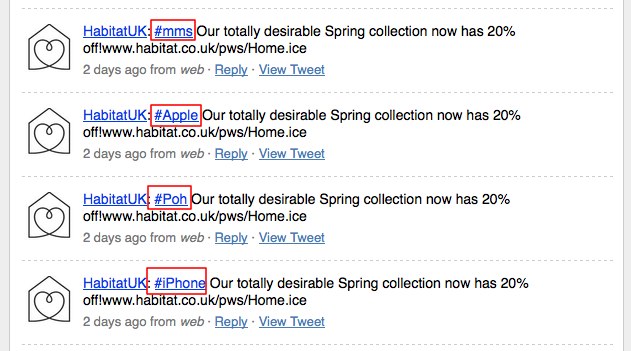
I think my biggest concern on this whole story is the rather cavalier way that Habitat has treated a social media platform, and for a consumer facing brand these days that's a fairly major issue.
Wednesday, 1 April 2009
@guardian. Funny, no really, very funny
Apparently the Guardian newspaper is now only going to be available by Twitter.
And I quote...
Consolidating its position at the cutting edge of new media technology, the Guardian today announces that it will become the first newspaper in the world to be published exclusively via Twitter, the sensationally popular social networking service that has transformed online communication.
Fantastic story. And what a great day to publish it. Time to sit back and see how many social media consultants fall for it.
And I quote...
Consolidating its position at the cutting edge of new media technology, the Guardian today announces that it will become the first newspaper in the world to be published exclusively via Twitter, the sensationally popular social networking service that has transformed online communication.
Fantastic story. And what a great day to publish it. Time to sit back and see how many social media consultants fall for it.
Thursday, 5 March 2009
Simples
For those of us in the UK, undoubtedly one of the most irritating ads on telly at the moment is one for a car insurance comparison website, called CompareTheMarket.com It's fronted by a meerkat with a Russian accent, who complains about people getting confused with his site, CompareTheMeerkat.com.
"Meerkat, market, they are different things, no? Simples."
But it's a really clever use of social media tools - now our little Russian meerkat front man (who is called Aleksandr Orlov) now has his own Facebook page, (with >250K fans!) and is happily Twittering away. In broken English. To 6,880 followers, all of whom get a personal message when they join, and who appear to be in avid conversation with him on a fairly constant basis...
"Have a very happy birthday! Maybe celebrate with a piece of cake or a new cravat?"
...is a good example of his work - the tone and engagement with his followers is really spot on, and a good learning experience for anyone who want's to really get involved in this space, particularly on a b2c brand like this.
The agency behind this is VCCP, digital strategy by Amelia Torode, and details of their campaign can be found on their site here.
Learnings?
- use appropriate channels. Facebook and Twitter are great in a situation like this - they create an interaction that invites people into the brand and creates loyalty (not easy in the overcrammed somewhat scuzzy world of car insurance comparison sites!)
- use appropriate tone of voice. Anthropomorphosising car insurance into a Russian meerkat (now there's a sentence I'd never thought I would write!) allows soft selling of the product into a warm, receptive audience. Compare that with the Churchill or Admiral insurance products in the UK where they have tried something similar and just ended up being irritating!
- update your content as appropriate. There are only 2 TV ads at the moment - yet the Twitter channel gets attention daily, as does the Facebook page, to keep the audience engaged. Facebook seems to be updating itself at the moment, with fan videos and over 700 photos uploaded.
- don't be afraid to be a bit weird, and take risks. Facebook and Twitter can be risky, but your audience is much more forgiving - as with many social media environments they appreciate that it's a bit more informal, and you can get away with a lot more than you might otherwise do on your product/corporate website.
Simples!
Wednesday, 4 March 2009
More on Ryanair and social media reputation comes from this post by Joanna Higgins on bnet.com.
As well as her take on the whole blogging response from the world's rudest airline, she reports on the Kaizo Advocacy Index, latest version released for Winter. They review online reputation, and measure 20 brands across 4 sectors - food, airline, software and mobile - against how they fair in social media platforms. Lots of talk here of the influence of both Twitter and Facebook (although I'm pretty sceptical about both to be honest).
There's an overview presentation below:
Useful reading before you buy a phone or travel on an airline. Or buy ERP software for millions (I wish our IS&T teams had read this....!)
This is similar to the work we do here at Rio Tinto on a monthly basis (service provided by the guys at Market Sentinel), and it's a useful weathervane on how the world is perceiving your communications efforts.
As well as her take on the whole blogging response from the world's rudest airline, she reports on the Kaizo Advocacy Index, latest version released for Winter. They review online reputation, and measure 20 brands across 4 sectors - food, airline, software and mobile - against how they fair in social media platforms. Lots of talk here of the influence of both Twitter and Facebook (although I'm pretty sceptical about both to be honest).
There's an overview presentation below:
Kaizo Advocacy Index Winter 2009
View more presentations from guest542bc4.
Useful reading before you buy a phone or travel on an airline. Or buy ERP software for millions (I wish our IS&T teams had read this....!)

This is similar to the work we do here at Rio Tinto on a monthly basis (service provided by the guys at Market Sentinel), and it's a useful weathervane on how the world is perceiving your communications efforts.
Wednesday, 30 April 2008
Twittering in a corporate world
Well, we've just dipped our well manicured corporate toes in the dimly lit pool of microblogging, by signing up for an account on Twitter.
I'm not yet sure of the business value of this. Yes, it's an interesting platform for p2p comms, and I've even heard it holds some value for those b2c.
However I wait to see whether we get much out of it. It's success depends on who else has signed up on the site, and our stakeholders - hedge fund managers, NGOs, business journos and the like - are not reknowned for their early adoption of social media. (OK, by now it's not really early adoption, but you know what I mean...)
If the chickens aren't in the yard, there's no point scattering the corn.
People looking for a job on our student or graduate placements schemes may very well come across us though, so that's a good thing. Mind you, it's a difficult thing trying not to come across as "getting on down with the cool kids". That's not really a core brand value for a mining company such as ours, trust me.
We'll see how we go over the next few months. And who knows, getting our feet wet may well prove to have some payback. (Probably more so than stretching this particular metaphor).
I'm not yet sure of the business value of this. Yes, it's an interesting platform for p2p comms, and I've even heard it holds some value for those b2c.
However I wait to see whether we get much out of it. It's success depends on who else has signed up on the site, and our stakeholders - hedge fund managers, NGOs, business journos and the like - are not reknowned for their early adoption of social media. (OK, by now it's not really early adoption, but you know what I mean...)
If the chickens aren't in the yard, there's no point scattering the corn.
People looking for a job on our student or graduate placements schemes may very well come across us though, so that's a good thing. Mind you, it's a difficult thing trying not to come across as "getting on down with the cool kids". That's not really a core brand value for a mining company such as ours, trust me.
We'll see how we go over the next few months. And who knows, getting our feet wet may well prove to have some payback. (Probably more so than stretching this particular metaphor).
Subscribe to:
Posts (Atom)